 ResortSlopes
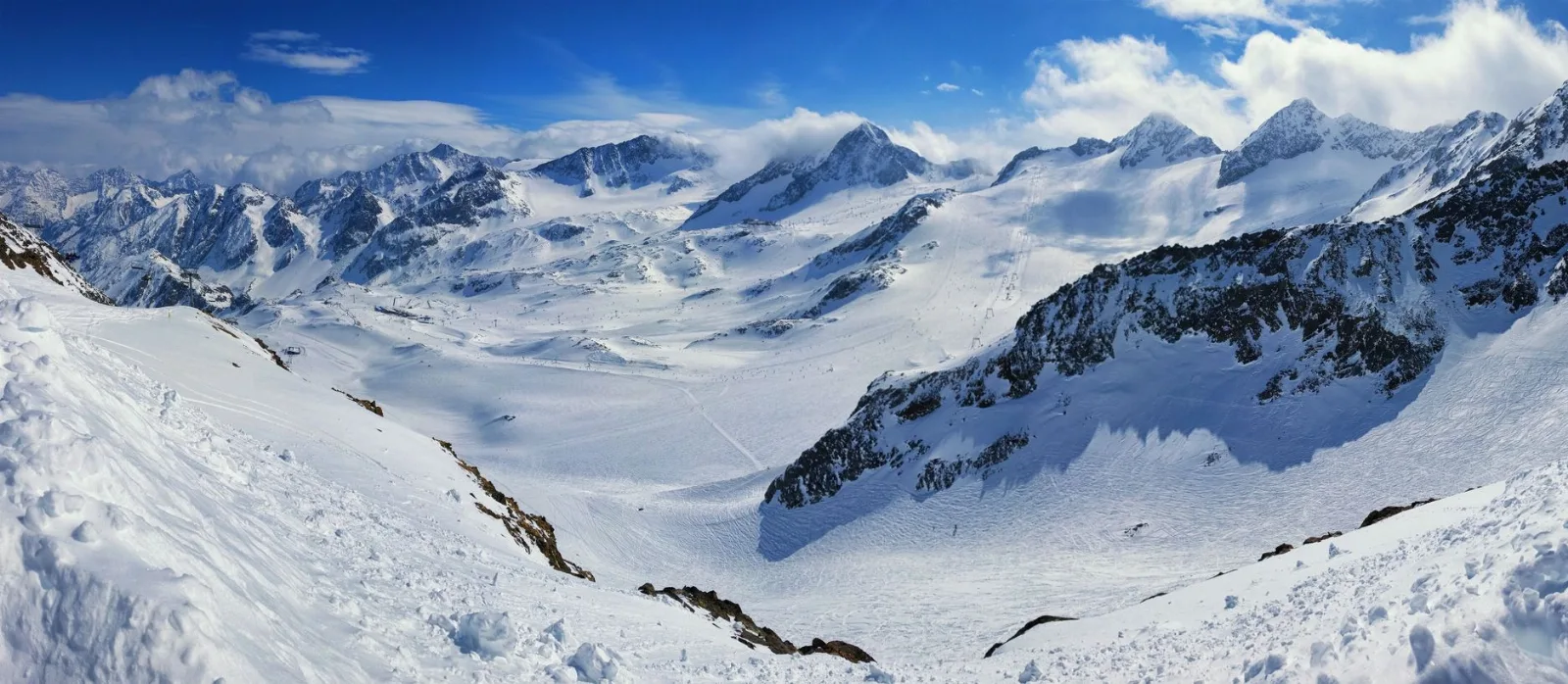
Highest Ski Resorts in the Alps: Which Are Most Snow-Sure?
Last reviewed 21 October 2026. Altitudes are published lift-served ranges taken from the resortslopes.com resort pages; always check each resort's current information.
If you want the best odds of good snow, look at the base altitude first and the summit second: among the resorts in our dataset, Val Thorens has the highest base (2,300 m) and Zermatt the highest lift-served point (about 3,883 m). Height improves the odds of reliable snow, but it never guarantees it.
Why does altitude matter for snow reliability?
Air cools with height, so precipitation falls as snow more often and the snowpack survives longer. The Swiss WSL Institute for Snow and Avalanche Research (SLF) reports that most stations below 1,300 m show a statistically significant trend towards less snowy winters, while above 2,000 m midwinter snow depths show no clear trend. The same SLF page notes that most stations at every altitude have fewer days with snow on the ground, mainly because spring melt arrives earlier.
A peer-reviewed regional climate-model study (Steger, Kotlarski, Jonas and Schär, Climate Dynamics, 2013) found the strongest relative reduction in winter snow water equivalent below 1,500 m, amounting to 40 to 80 percent by mid-century compared with 1971 to 2000. The authors link this to mean winter temperatures close to the melting point at those elevations. This is the scientific background behind the familiar 1,500 m rule of thumb. In a 2006 interview, an OECD researcher also said Swiss banks were refusing loans to ski operators below that height, which shows how widely the figure is used, although it is a lending remark rather than a measurement.
For the longer term, SLF scenario work says that if emissions are not reduced, the natural snowpack could shrink by up to 70 percent by the end of the century, and that only above 2,500 m would natural snow be enough for profitable ski resorts. Those are projections, not forecasts for any particular winter.
Which Alpine ski resorts have the highest base altitude?
The table ranks the resorts in our dataset by the height of the valley or base area. Sestriere is included for its base figure only.
| # | Resort | Base altitude |
|---|---|---|
| 1 | Val Thorens | 2,300 m |
| 2 | Breuil-Cervinia | 2,050 m |
| 3 | Sestriere | 2,035 m |
| 4 | L'Alpe d'Huez | 1,860 m |
| 5 | Val d'Isère | 1,850 m |
| 6 | St. Moritz | 1,822 m |
| 7 | Livigno | 1,816 m |
| 8 | Saas-Fee | 1,800 m |
| 9 | Zermatt | 1,620 m |
| 10 | Tignes | 1,550 m |
Crans-Montana and Verbier follow at 1,500 m each. Several famous names sit lower: Chamonix-Mont-Blanc starts at 1,035 m, Mayrhofen at 630 m and Kitzbühel at 762 m. Low bases are not a flaw in themselves, since many of these areas have high terrain above them, but the village-level pistes are more exposed to warm spells.
Which Alpine ski resorts reach the highest summits?
Here the ranking uses the top of the lift-served terrain. Sestriere is left out because its summit figure is not in our dataset. The Zermatt figure is the official height of the Matterhorn Glacier Paradise station on the Klein Matterhorn, published by the Zermatt lift company as the highest mountain station in Europe.
| # | Resort | Summit altitude |
|---|---|---|
| 1 | Zermatt | 3,883 m |
| 2 | Saas-Fee | 3,600 m |
| 3 | Breuil-Cervinia | 3,480 m |
| 4 | Tignes | 3,456 m |
| 5 | Val d'Isère | 3,456 m |
| 6 | Sölden | 3,340 m |
| 7 | L'Alpe d'Huez | 3,330 m |
| 8 | Verbier | 3,330 m |
| 9 | Chamonix-Mont-Blanc | 3,275 m |
| 10 | La Plagne | 3,250 m |
Val Thorens, whose base is the highest of all, tops out at 3,230 m, just outside the top ten. That is why it makes sense to read both tables together: a resort with a high base and a high summit has the whole mountain above the risky zone, while a resort with a low base and a high summit relies on its upper slopes.
What do these altitude figures not tell you?
- They are published ranges. Resorts quote lift-served heights in different ways, and the highest lift is not always open or connected to every piste.
- Glaciers change the picture. Saas-Fee, Zermatt and some other high areas offer glacier terrain, which can open earlier or stay open later than ordinary slopes. Glaciers are also retreating.
- Snow cannons change it too. Snowmaking can keep key runs open at lower resorts, but it needs cold enough nights and it does not replace natural snowfall.
- Aspect and shelter matter. North-facing slopes hold snow longer than sunny ones at the same height.
- Weather varies. Any single season can be snowy or poor at any altitude. Do not read the rankings as a promise.
How should you use this ranking when planning a trip?
Use altitude as a first filter, then check the current snow report and lift status published by the resort. Early December and late April are the most sensitive periods, and high resorts are the safer choice for those weeks, though not a certain one. For timing across the whole season, see our guide to the best time to ski in the Alps. If you prefer a lower, tree-lined area, remember that it tends to do best in the middle of winter and may need more flexibility on dates.
Altitude is a useful rule of thumb, backed by Swiss and European research, but every winter is different. Treat the ranking as a way to shortlist resorts, not as a snow guarantee.
What the sources say
Every note below is drawn from the resort's own or an independent official publication.