 ResortSlopes
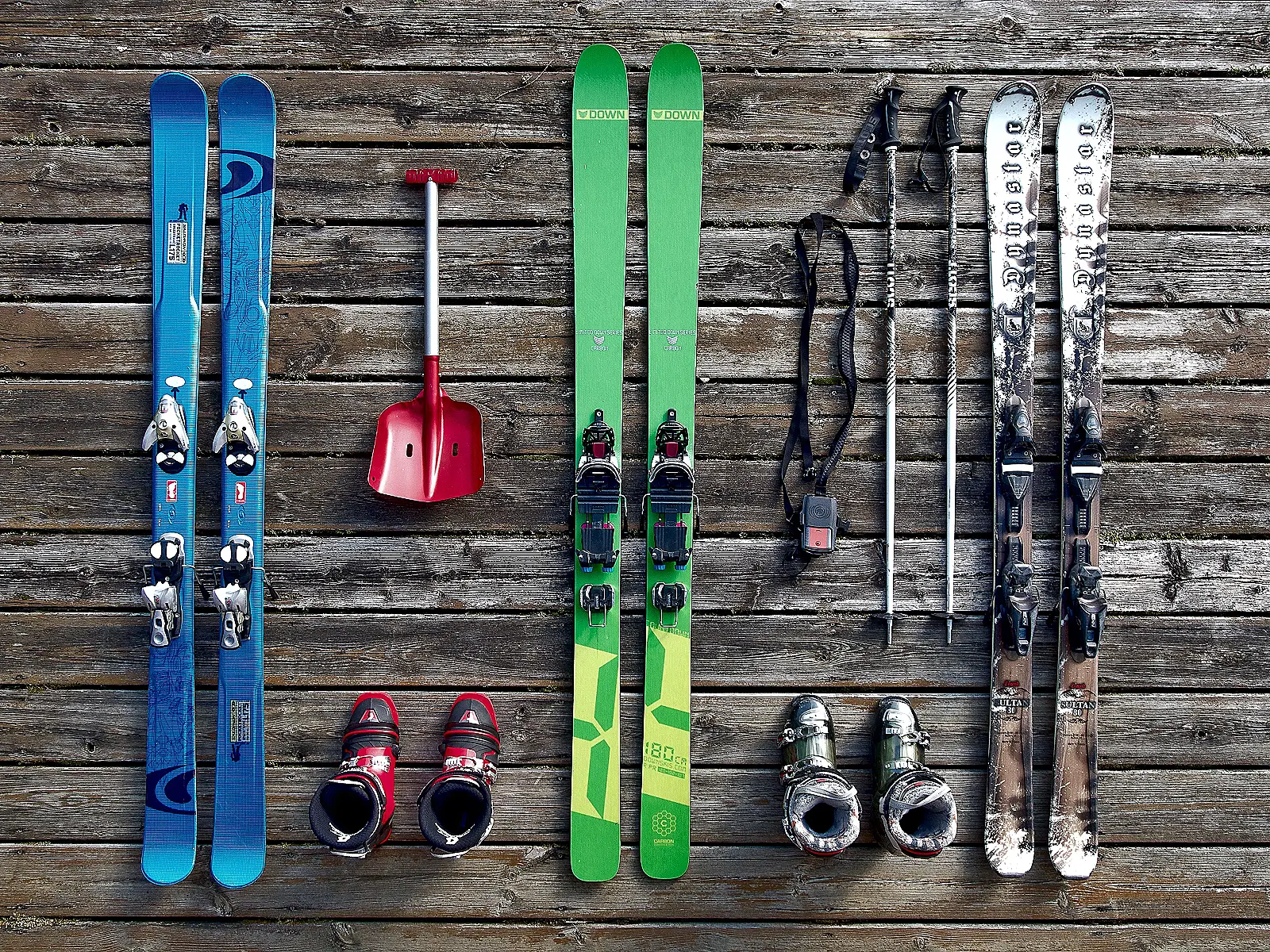
What Gear You Actually Need for a Ski Trip
A ski trip does not require an equipment room's worth of specialist purchases before your first run. Most of what determines whether you are warm, dry, and comfortable on the mountain comes down to a handful of categories, each with a genuine rent-versus-buy calculation behind it. This guide breaks those categories down by what they do, what to look for, and when it makes sense to own rather than hire.
Layering: The System That Actually Matters
Alpine weather changes fast — a lift ride can take you from a sheltered, sun-warmed base to a windy, sub-zero summit in minutes. A three-layer system lets you manage that range without carrying a wardrobe.
Base layer
Worn against the skin, its job is to move sweat away from your body, not to provide warmth by itself. Merino wool and synthetic technical fabrics (polyester/polypropylene blends) both work; cotton does not, because it holds moisture against the skin once you start working hard, which becomes a liability the moment you stop moving in the cold. Weight (lightweight, midweight, expedition-weight) should match your own metabolism and the conditions — a fast-moving intermediate generating a lot of body heat needs less insulation here than someone spending long periods stationary in a lesson.
Mid layer
This is your adjustable insulation: a fleece, a light synthetic or down jumper, or both, added or removed depending on temperature. Because it is the layer you will swap most often through the day, it is also the one most sensible to build up gradually rather than buy all at once — an old fleece from another sport does the job.
Outer layer (shell)
The ski jacket and pants need to be genuinely waterproof and windproof, not just water-resistant, plus breathable enough to vent the heat you generate on the way down. Look at the manufacturer's waterproof/breathability rating rather than the brand name, and check for practical details: snow skirts, wrist gaiters, pit zips for venting, and a helmet-compatible hood. Outer shells are also the layer most worth owning if you ski more than once a season, since fit matters more here than in any rental item and a well-fitted shell will outlast several seasons.
Boots: The One Item Worth Getting Right
Ski boots are the single biggest factor in whether a beginner or intermediate has a good day on snow, because a poorly fitted boot causes pain, cold feet, and loss of control regardless of skiing ability. For occasional skiers (roughly one trip a year or fewer), renting on arrival — from a shop that does a proper fitting, not just handing over a size — is the practical choice, since resort rental fleets are updated regularly and fit can be adjusted mid-trip if something is wrong. Skiers who go several times a season, or whose feet are hard to fit off the shelf, generally benefit from owning boots: a boot fitted once (ideally with a professional bootfitting session, including footbed and shell adjustments where needed) performs consistently every time, and eliminates the fitting-queue time at the start of each trip.
Helmet
Helmet use among skiers and snowboarders has risen sharply over the past two decades and is now the norm rather than the exception in most well-monitored markets. In the United States, participant helmet-use rates tracked by the National Ski Areas Association rose from roughly a quarter of skier visits in the early 2000s to over 90 percent in recent seasons, with even higher rates among skiers under 18. That data is US-specific, but it reflects a broader industry-wide shift toward helmets being treated as standard kit rather than optional safety gear.
Legal requirements, however, are inconsistent across the Alps, and this is worth checking before you travel rather than assuming:
- Italy made helmets legally mandatory for all skiers and snowboarders, of all ages, on its pistes from November 2025 — the first Alpine country to require it universally, with on-the-spot fines for non-compliance.
- Austria requires helmets for children up to 15 in most federal states, though rules vary regionally — Tyrol and Vorarlberg are commonly cited as exceptions to the state-level mandate, though ski schools there often require helmets for young learners regardless of the legal minimum.
- France has no general legal requirement for skiers of any age to wear a helmet, though French ski schools typically require them for enrolled students.
Practically: fit matters more than price. A helmet should sit level on the head, cover the forehead without pressing on it, and be compatible with your goggles so there is no gap at the temple. Rental helmets are widely available and perfectly adequate for occasional skiers; frequent skiers may prefer to own one for consistent fit and hygiene.
Goggles
Goggles are not interchangeable with sunglasses on the mountain — they seal against wind, spindrift, and cold at speed, and the lens tint should match conditions rather than be a single all-purpose choice. Darker lenses suit bright, sunny days at altitude; lighter, rose- or yellow-toned lenses improve contrast on flat light or overcast days when terrain features are hard to read. Skiers who go out in mixed conditions often carry, or buy, a goggle with an interchangeable or photochromic lens rather than committing to one fixed tint. Anti-fog coating and adequate venting are functional necessities, not upsells — fogged goggles are a genuine safety issue at speed.
Gloves and Mittens
Waterproofing and insulation matter more here than style. Mittens are generally warmer than gloves for a given thickness because fingers share warmth, which suits beginners spending a lot of time stationary; gloves give better dexterity for buckles, poles, and phones, which suits more mobile skiers. A wrist leash is a small feature worth having, since a dropped glove on a windy chairlift is a genuine inconvenience.
Sun Protection at Altitude
UV exposure at altitude is measurably higher than at sea level, and this is a real, physical effect rather than general caution. Thinner atmosphere at altitude filters out less ultraviolet radiation. Estimates of exactly how much UV increases with elevation vary between sources — figures commonly cited include roughly 10 percent or more per 1,000 metres of elevation gain, though some studies give ranges that are considerably wider depending on how the increase is measured, so treat any single percentage as an approximation rather than a fixed constant. On top of that, snow itself reflects a very large share of incoming UV radiation back upward — considerably more than grass, sand, or bare ground — so skiers are exposed to UV from above and reflected from below at the same time. Combined, UV readings measured at ski fields have been recorded well above equivalent sea-level exposure at the same latitude.
The practical response: high-SPF, broad-spectrum sunscreen reapplied through the day (not just once at the base), lip balm with SPF, and UV-blocking lenses in both goggles and any sunglasses used off-piste. This applies on overcast days too, since UV penetrates cloud cover far more than visible light does.
Budget Tiers: What to Own vs What to Rent
| Item | First trip / occasional skier | Regular skier (multiple trips/season) |
|---|---|---|
| Skis/board and poles | Rent | Own once you know your preferred style and terrain |
| Boots | Rent, with a proper in-shop fitting | Own — fit consistency pays off quickly |
| Helmet | Rent | Own, for fit and hygiene |
| Goggles | Buy a basic pair — cheap to own, awkward to rent hygienically | Own, consider interchangeable lenses |
| Outer shell (jacket/pants) | Buy or borrow — fit matters, rental shells vary widely in quality | Own |
| Base/mid layers, gloves | Buy — inexpensive and usable beyond skiing | Own |
The general pattern: items that touch skin, need a close fit, or are hard to hire hygienically (goggles, gloves, base layers) tend to be worth owning even on a first trip. Items that are expensive, need matching to ability and terrain, or benefit from professional fitting on arrival (skis, boots) are more often better rented until you know what you actually want.
What the sources say
Every note below is drawn from the resort's own or an independent official publication.