 ResortSlopes
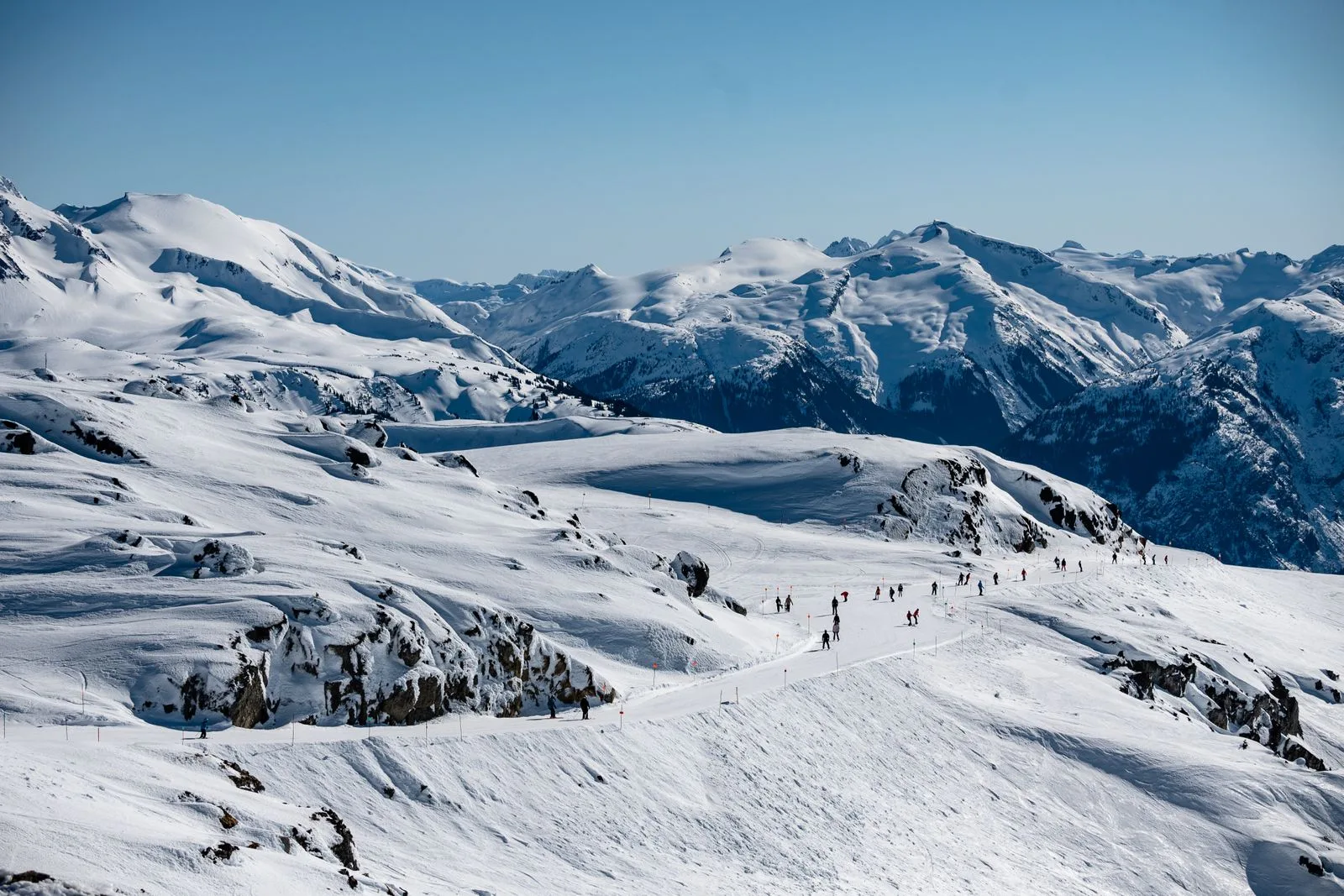
Skiing in Canada: Whistler, Banff, Lake Louise, Revelstoke, Mont-Tremblant
Last reviewed 2 November 2026. Figures come from each resort's own pages, Parks Canada and tourism boards; resorts revise their statistics and season dates every year, so confirm them on the official pages before you book.
Skiing in Canada means four quite different regions: the Coast Mountains around Whistler, the Rockies of Banff National Park (Sunshine Village and Lake Louise), the interior of British Columbia (Revelstoke) and the Laurentians of Quebec (Mont-Tremblant). Summits sit between roughly 875 m and 2,640 m, vertical drops range from 645 m to 1,713 m as published, and the nearest big airports are Vancouver, Calgary, Kelowna and Montréal. This guide is about ski areas outside the Alps, so Alpine habits and calendars only partly carry over.
How is Canadian skiing split into regions?
Canada is not one ski region, and the five resorts here are far apart. Whistler Blackcomb is on the Pacific side of British Columbia and is reached by the Sea to Sky Highway (Highway 99) from Vancouver. Banff Sunshine Village and Lake Louise are in Alberta, inside Banff National Park, in the Rockies. Revelstoke is in the interior of British Columbia, between the Rockies and the coast. Mont-Tremblant is in the Laurentians in Quebec, in the east of the country.
The practical consequence is that you do not combine them in one trip the way you might combine two Alpine valleys. Distances are long: the resort's own page puts Revelstoke 413 km from Calgary and 631 km from Vancouver by road. If you are used to the Alpine seasons described in our Alps timing guide, treat that guide as background only; it does not describe Canadian conditions.
What altitudes and vertical drops do the resorts publish?
Altitude is modest compared with the high Alps, and the vertical drop is what the resorts emphasise. The table uses only figures from each operator's own pages; "not stated" means the page we checked does not give the number.
| Resort | Base | Top | Vertical | Terrain |
|---|---|---|---|---|
| Whistler Blackcomb | 675 m | 2,284 m (highest lift-accessed point) | not stated | 8,171 acres (about 3,300 ha) |
| Lake Louise | not stated | 2,637 m | 991 m | 1,700 ha (4,200 acres) |
| Revelstoke | 512 m | 2,340 m (Sub Peak); top of the Stoke chair 2,225 m | 1,713 m | 3,121 acres (about 1,260 ha) |
| Mont-Tremblant | not stated | 875 m | 645 m (south side) | about 309 ha (763 acres) |
| Banff Sunshine Village | not stated | top of The Great Divide at 8,900 ft (about 2,710 m) | not stated | 3,300 to 3,500 acres, depending on the resort page |
Two notes on reading this. First, the gaps are real: Whistler's page lists its base and highest lift-accessed elevation but no vertical drop, although subtracting one from the other gives 1,609 m. Second, Banff Sunshine Village is the one where our own stored data (a base of 1,660 m and a top of 2,730 m) could not be matched to the resort's pages, so we leave out a base and vertical for it rather than guess. Mont-Tremblant's summit and south-side vertical come from the resort's statistics page; subtracting gives a base near 230 m, which matches what we store.
How many lifts and runs, and how hard are they?
Whistler Blackcomb lists 36 lifts, more than 200 marked runs, 16 alpine bowls and three glaciers. It publishes its terrain as 20% easiest, 35% more difficult, 25% most difficult and 20% experts only. Our stored record shows 27 lifts, so that figure is out of date against the resort's current page.
Lake Louise lists 13 lifts (one gondola, nine chairs and three carpets), 171 named runs across five mountain faces and a longest run of 8 km, with terrain split 25% beginner, 45% intermediate and 30% advanced. Revelstoke lists 75 runs, a split of 12% green, 43% intermediate and 45% advanced, and a longest run, The Last Spike, of 15.2 km; its page names a gondola and three chairlifts. Mont-Tremblant lists four sides of the mountain and a longest trail, Nansen, of 6 km. Banff Sunshine Village describes three mountains (Goat's Eye, Lookout and Mount Standish) and a freeride zone, Delirium Dive, whose gate is at the top of the Divide Express; it gives no run count on the pages we read.
Notice that the labels differ from resort to resort: "easiest" to "experts only" at Whistler, "beginner" to "advanced" at Lake Louise, green, intermediate and advanced at Revelstoke. We did not find an official Canada-wide grading standard, so read the legend on each trail map. For the general logic of colours and difficulty, see piste difficulty explained, and for how North American signs differ from Alpine ones, see our guide to skiing in the USA.
What does it mean that Sunshine and Lake Louise are in a national park?
Parks Canada describes Banff as Canada's first national park and as part of the Canadian Rocky Mountain Parks UNESCO World Heritage Site. Both ski areas sit inside it. Parks Canada manages them under its 2006 Ski Area Management Guidelines and a separate set of site guidelines for each area; the Lake Louise guidelines date from 2015 and the Sunshine Village guidelines were approved in December 2018.
For a skier the effect is a fixed footprint. Parks Canada says the Sunshine Village site guidelines cap total skiable terrain at 511 ha and the number of skiers at one time at 8,500, approve a daily capacity of 6,000, and return about 61 ha of the current 917 ha lease to protection. It describes the resort as about 15 minutes outside the town of Banff. Do not expect these areas to grow the way a private-land resort can; the limits are written down.
When do the resorts open in 2026/27?
Only dates the operators themselves have published are given here, and all can change with snow and weather.
- Whistler Blackcomb's hours page lists Blackcomb from 20 November 2026 to 16 May 2027, and Whistler Mountain from 25 November 2026 to 18 April 2027.
- Revelstoke's events page says Opening Day is set for Saturday, 5 December 2026; we found no published closing date for the 2026/27 winter.
- Lake Louise says its season pass covers skiing from 6 November 2026 to 2 May 2027, and links to an earlier opening on 1 November. Treat these as pass dates and check the resort's daily operating status.
- Banff Sunshine Village describes a long season and says its season pass is on sale; we did not find an official opening or closing date for the lifts, so check its hours page.
- Mont-Tremblant: we could not read an official 2026/27 date, so none is given here.
The seasons stored on our resort pages (for example early November to late May at Sunshine and late November to mid-April at Tremblant) are typical windows, not promises.
Which airports and transfers are realistic?
For Whistler the usual gateway is Vancouver International Airport; Whistler's tourism site gives roughly 2 to 2.5 hours by road along Highway 99, and shuttle operators quote 2.5 to 3 hours depending on traffic and weather. For Banff and Lake Louise it is Calgary International Airport: Banff Lake Louise Tourism gives about 130 km and 90 minutes to Banff, and Lake Louise Ski Resort gives about 184 km and 2 hours from Calgary to Lake Louise, with Banff to Lake Louise about 60 km.
Revelstoke publishes its own table: Kelowna International Airport is its main gateway at 199 km and about 2.5 hours, Calgary is 413 km and about 4.75 hours, and Vancouver is 631 km and about 7 hours. Mont-Tremblant lists a shuttle from Montréal-Trudeau International Airport; we could not confirm a distance or time from an official page, so check the shuttle page. Winter driving on mountain highways can add time.
How should you choose between them?
Start from geography and flight routing, not from the table. If you want a large, lift-rich area on the coast, Whistler Blackcomb publishes the most lifts and marked runs of the five. If you want to combine skiing with a national park setting, look at Lake Louise and Sunshine: Banff is about 60 km from Lake Louise, and Sunshine is about 15 minutes outside Banff. Revelstoke publishes the largest vertical drop in the table and the longest run, but its nearest major airport is a 2.5-hour drive away. Mont-Tremblant is lower, at 875 m, and sits in a different climate from the western resorts; it is the practical option if you are flying into eastern Canada.
What the sources say
Every note below is drawn from the resort's own or an independent official publication.